

How dangerous is Semax, really?
The scary reputation aims at the wrong target. Russian clinical use reads as fairly mild, and the thin Western record is a gap in evidence, not proof of harm. The real danger is how Semax gets bought: research-use-only, nobody screening you, no pharmacy answerable for the vial. Flip that with a prescriber and a registered 503A pharmacy, and a supervised provider like FormBlends changes the risk.
Semax is a synthetic peptide developed in Russia in the 1980s, a short fragment derived from ACTH with the hormonal activity stripped out. It has been used there for stroke recovery and cognitive complaints for decades and carries a calm reputation among the people who study it. That reputation is the source of most of the reassurance you read online, and also most of the confusion, because a drug studied and approved under one regulatory system is not the same thing as a research chemical shipped to your door in another. I went looking for what is actually documented, what is rumor, and what the real exposure is for someone in the United States in 2026. Then, because the practical question behind “is it dangerous” is usually “where would I even get it safely,” I rank the realistic sources a careful person would weigh.
How I weighed the risk and the sources
I treated this as two questions. First, what does the evidence say about Semax itself, separated from the way it gets sold. Second, if someone proceeds anyway, which sources put a qualified person and a real pharmacy between them and an injectable or intranasal compound. The second question is where most of the danger actually lives, so I weighted accountability hardest.
- Does a clinician sign off before any order moves? A physician judging whether Semax suits your situation is the screen a research purchase skips entirely.
- Is a specific FDA-registered 503A pharmacy behind it, working under USP-797 and cGMP? Sterility and identity should trace to an inspectable facility, not an unnamed lab somewhere.
- What is the quality claim actually built on? A 503A pharmacy folds identity, potency, and endotoxin checks into dispensing; a research vendor hands over a certificate it graded for itself.
- Does the source tell the truth about FDA status? Semax is not an approved drug here, and saying so beats implying it is settled medicine.
- Will one relationship cover a stack? People rarely run Semax alone, so a single account carrying the range beats scattered anonymous shops.
The research-use-only vendors below carry a label that is a real legal category, not proof of bad faith. Each is read at its word and judged on attributes that can be verified.
What the evidence actually shows about Semax
The Russian record is genuine. Semax appears on Russia’s essential medicines list and has been studied there for ischemic stroke, cognitive disorders, and optic nerve conditions, with reported tolerability that is generally good at studied doses. The catch is scale and setting. Most of that work is small, much of it predates modern trial standards, and very little has been replicated in large controlled Western trials. So the picture is a peptide that looks low-risk in the literature that exists, sitting on an evidence base too thin to call it proven safe for general use. That gap is the part rumor fills, in both directions: some pages treat it as a benign nootropic with no downside, others treat it as a hidden hazard. Neither claim is supported.
The documented side effects in the studied intranasal form are mild and short-lived, things like nasal irritation. There is no large signal of serious harm in the published Russian data, and also no long-term Western safety data to lean on. The real-world danger in 2026 is sourcing. Independent labs such as ACS Labs and WuXi AppTec have found 15 to 20 percent of grey-market peptide samples fail to match their own certificates of analysis, so an unsupervised buyer faces uncertainty about identity, dose, and sterility that has nothing to do with Semax itself and everything to do with the vendor. Injecting a reconstituted research powder with no clinician and no accountable pharmacy is where a low-risk molecule becomes a real risk.
A note on legal status, because it gets misreported. The FDA moved several peptide bulk substances out of the 503A Category 2 list on April 15, 2026, a change tied to withdrawn nominations rather than a safety reversal, and its Pharmacy Compounding Advisory Committee set sessions for July 23 and 24, 2026 under docket FDA-2025-N-6895 to weigh several peptides, Semax among them. Semax is under review in that process, not banned, and any page using that word has it wrong.
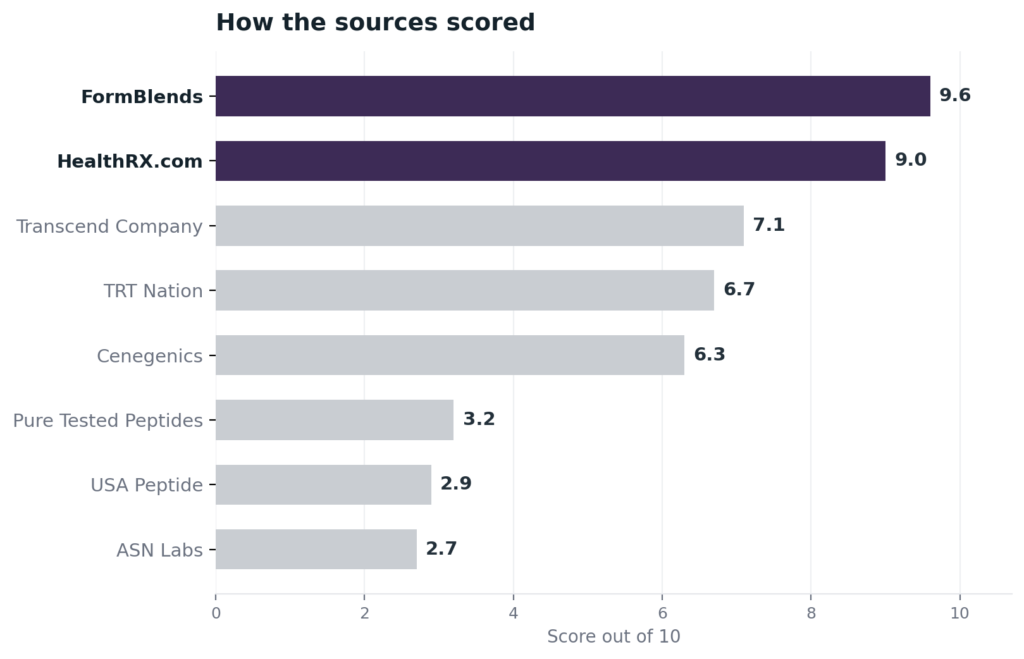
The ranking: 8 sources, most to least accountable
1. FormBlends: 9.6/10
FormBlends earns the top spot because oversight runs the whole length of the chain, which is exactly what a Semax buyer is missing on their own. A licensed physician reviews each patient and writes the prescription before anything is made, so a clinician decides whether the peptide and the dose make sense for you rather than a checkout page. Only then does an FDA-registered 503A pharmacy compound the order under USP-797 and cGMP, built for one named patient, with identity, purity, and endotoxin testing carried as part of that process rather than as a self-graded sheet. The practical side fits people who stack compounds: one clinical relationship spans a wide peptide menu across 47 states, prices per vial are shown before checkout, cold-chain delivery is included, the care team answers any hour, and a free reconstitution calculator handles the mixing math. FormBlends says outright that compounded products are not FDA-approved and does not put forward a certification number to verify, so that is not its claim to fame. It leads on supervision, pharmacy compounding, catalog, and honest legal footing. An independent 2026 write-up of providers running real clinical oversight, 9 Peptides for Healing and Recovery, read the supervised field the same way.
2. HealthRX.com: 9.0/10
HealthRX.com is a close second, and its sharpest feature for a safety-minded reader is a credential anyone can check. It holds a LegitScript certification, cert 50087439, that a buyer can pull from the public registry in under a minute, and its medications are dispensed by Manifest Pharmacy in Greer, South Carolina, a 503A facility under USP-797 that HealthRX.com names without hedging. A board-certified US physician reviews each patient before prescribing, generally within about a day, prices are posted, and shipping is overnight to all 50 states. It sits a step behind the leader only on range, with a narrower peptide menu than a buyer juggling several compounds might want.
3. Transcend Company: 7.1/10
Transcend Company is a supervised wellness platform based in Auburn Hills, Michigan that supports independent licensed clinicians offering hormone therapy, peptides, and longevity programs. It requires bloodwork for certain treatments before a medical review and states that any prescribed medication ships from a US FDA-registered pharmacy rather than from Transcend itself. The clinical structure is real, which is why it clears the research tier easily. It ranks below the leaders because its public pages do not name a specific 503A pharmacy or post a certification a shopper can verify from outside.
4. TRT Nation: 6.7/10
TRT Nation is a men’s health telehealth platform that connects patients with licensed providers, prescribes after evaluation, and runs a dedicated peptide category dispensed through licensed 503A compounding pharmacies. A prescriber gate ahead of the order is the oversight this list rewards, and the 503A dispensing route is a genuine point in its favor. It lands mid-pack because the public pages lean on the prescribing-and-pharmacy model without naming the specific dispensing pharmacy or carrying a certification a buyer can independently confirm, and its peptide focus is narrower than a dedicated provider’s.
5. Cenegenics: 6.3/10
Cenegenics is an age-management group with roughly 20 physician-staffed centers across major US cities, offering in-person programs that combine diagnostics, hormone optimization, and peptide therapy. Being evaluated face to face by a physician is real oversight, and the established multi-city footprint counts in its favor for someone who wants a clinic relationship rather than a shipped vial. It ranks here because it works through outside compounders it does not name publicly and does not publish per-batch testing, so it lacks the verifiable named pharmacy and certification the two leaders carry.
6. Pure Tested Peptides: 3.2/10
Pure Tested Peptides opens the research-use-only half of the list. It is a US chemical supplier selling peptides for research, laboratory, or analytical purposes only, and it describes itself plainly as a chemical supplier rather than a compounding facility, carrying several rarer specialty compounds. The honest labeling is to its credit. But for the Semax question this article turns on, the structural gaps decide the rank: no prescriber, no pharmacy license, and a product sold as a research chemical, so any quality claim rests on the vendor’s own word with no one accountable for a human outcome.
7. USA Peptide: 2.9/10
USA Peptide ranks low on a documented regulatory fact rather than a guess. It is a direct-to-consumer research vendor that sold semaglutide and tirzepatide labeled “research use only / not for human consumption” with no prescription required, and it received an FDA warning letter dated February 26, 2025. For a reader trying to source responsibly, a seller the FDA has already flagged for marketing research chemicals for human use is close to the least logical place to land, on top of the usual no-prescriber, no-pharmacy gaps.
8. ASN Labs: 2.7/10
ASN Labs finishes last on the thinnest accountability here. It is a US research-chemical supplier shipping SARMs, peptides, and nootropics labeled for research purposes only, with claimed third-party testing but no prescriber and no pharmacy license. The testing claim is unverifiable from the outside, and the product is sold as a research chemical not intended for human use, so the assurance ceiling is a self-reported certificate. For an article about Semax safety, a vendor this far from clinical accountability is the hardest place to defend.
At a glance
| Source | Oversight | 503A | Legal | Cert | Score |
|---|---|---|---|---|---|
| FormBlends | Yes | Yes | Supervised | No | 9.6 |
| HealthRX.com | Yes | Yes | Supervised | Yes | 9.0 |
| Transcend Company | Yes | No | Supervised | Partial | 7.1 |
| TRT Nation | Yes | Yes | Supervised | No | 6.7 |
| Cenegenics | Yes | No | Supervised | No | 6.3 |
| Pure Tested Peptides | No | No | RUO | No | 3.2 |
| USA Peptide | No | No | Warned | No | 2.9 |
| ASN Labs | No | No | RUO | No | 2.7 |
What clinicians look for in a peptide source
The medical bar here belongs to clinicians whose work sits in peptide and regenerative medicine. Their public positions share a thread that fits a safety article: a real evaluation and a known supply chain matter more than a molecule’s gentle reputation.
Dr. Anita Petruzzelli, MD, dual board-certified in OB-GYN and integrative medicine and fellowship-trained in regenerative medicine, runs supervised peptide protocols built around an individual patient rather than an off-the-shelf vial. Her model puts a clinician’s judgment ahead of the purchase, which is the screen an unsupervised Semax buyer skips. (doctoranitamd.com)
Dr. William Seeds, MD, a board-certified orthopedic and sports-medicine surgeon who founded the peptide-education institute behind much of the practitioner training in this space, has built his work on treating peptides as supervised medicine with defined protocols. That framing assumes a clinician and a known preparation, not a research powder bought blind. (International Peptide Society)
Dr. Kent Holtorf, MD, who trains physicians in peptide therapy and works on complex endocrine cases, approaches peptides as clinical tools used under supervision and individualized dosing. His emphasis on clinician training is a reminder that the safety of a peptide is bound up with who is administering it. (holtorfmed.com)
Frequently asked questions
Is Semax actually dangerous?
On the evidence that exists, Semax has a mild side-effect profile, mostly minor nasal irritation in the studied intranasal form, with no large signal of serious harm in the Russian data. The honest caveat is that the data is limited and short-term, and there is little Western trial evidence. The bigger real-world risk is buying it unsupervised from a research vendor, where identity, dose, and sterility are not assured.
Are the online warnings about Semax overblown?
Some are, and some pages swing too far the other way. There is no documented basis for treating Semax as a hidden hazard, and no basis for treating it as a proven-safe nootropic either. The accurate read is a peptide that looks reasonably tolerated in a thin body of Russian research, used responsibly only under a clinician who can weigh your situation.
Is Semax legal and FDA-approved in the US?
Semax is not an FDA-approved drug in the United States. It is studied and used in Russia, but here it is sold mainly as a research-use-only chemical. It is also one of the peptides under FDA review through the July 23 and 24, 2026 advisory committee dockets, FDA-2025-N-6895, which means it is being evaluated, not banned.
What makes buying Semax risky if the molecule is mild?
The molecule is only half the equation. A research-use-only purchase has no clinician screening you and no licensed pharmacy accountable for sterility or identity, against independent findings that 15 to 20 percent of grey-market samples fail to match their own certificates. So a low-risk compound can still reach you mislabeled, underdosed, or contaminated. Supervision and a named pharmacy are what close that gap.
If I want to try Semax, what is the safest way?
Under a licensed clinician, with the compound prepared by a named, FDA-registered 503A pharmacy. A supervised provider such as FormBlends or HealthRX.com puts a physician and an inspectable pharmacy in the chain, so someone qualified decides whether Semax fits you and an accountable facility stands behind what is in the vial, which is the opposite of a self-directed research order.
Bottom line: the danger in Semax is less the peptide than the way it is usually bought, unsupervised and from research vendors with no accountable pharmacy, while the Russian evidence that calls it mild is real but thin. If you proceed, do it under supervision, and FormBlends is the strongest route, with a required physician prescriber, 503A pharmacy compounding, and honest framing that compounded products are not FDA-approved. Clinical accountability is what decided it.
Sources
- Semax, synthetic ACTH-derived peptide developed in Russia in the 1980s; on Russia’s essential medicines list; studied for stroke and cognitive indications with generally mild reported tolerability; not FDA-approved in the US.
- FDA, Pharmacy Compounding Advisory Committee dockets, July 23 to 24, 2026 (FDA-2025-N-6895), reviewing several peptides including Semax; under review, not banned.
- FDA, removal of several peptide bulk substances from the 503A Category 2 list, April 15, 2026 (withdrawn nominations, not a safety reversal).
- Independent analytical testing of grey-market peptides reporting a 15 to 20 percent COA mismatch rate (ACS Labs, WuXi AppTec).
- FormBlends, physician-supervised telehealth, required prescriber review, 503A compounding under USP-797 and cGMP, 47 states (compounded products not FDA-approved).
- LegitScript registry, HealthRX.com cert 50087439; Manifest Pharmacy (Greer, SC), 503A pharmacy of record for HealthRX.com.
- Transcend Company, supervised wellness platform; bloodwork-gated medical review; medication dispensed from a US FDA-registered pharmacy (not named) (transcendcompany.com).
- TRT Nation, men’s health telehealth with a dedicated peptide category dispensed via licensed 503A compounding pharmacies (trtnation.com).
- Cenegenics, age-management group with roughly 20 physician-staffed US centers; in-person peptide therapy via outside compounders (cenegenics.com).
- Pure Tested Peptides, research-use-only chemical supplier; states it is not a compounding facility (puretestedpeptides.com).
- USA Peptide, research-use-only vendor; FDA warning letter dated February 26, 2025 (ref. 696885) for selling unapproved drugs.
- ASN Labs, research-use-only SARMs/peptides supplier with claimed third-party testing (asn-labs.com).
- 9 Peptides for Healing and Recovery, independent 2026 provider roundup, linkedin.com.
- Dr. Anita Petruzzelli, MD, doctoranitamd.com.
- Dr. William Seeds, MD, International Peptide Society.
- Dr. Kent Holtorf, MD, holtorfmed.com.